Most coffee lovers hit this crossroad at some point. You’re standing in a kitchen store — or scrolling online at 1 AM — staring at a French press in one hand and a pour over dripper in the other. Both are manual. Both are affordable. Both promise a “better cup” than your old drip machine. So which one actually delivers?
Here’s the truth nobody tells you upfront: there’s no universal winner. The “better” method depends entirely on what you value in a cup of coffee — body, clarity, convenience, or ritual. And that’s exactly what we’re going to break down here, one honest detail at a time.
I’ve brewed thousands of cups with both methods over the years. Let me walk you through exactly what makes these two different, where each one shines, and which one fits your life — not just your taste buds.
How These Two Brewing Methods Actually Work
Before we compare anything, let’s make sure we’re on the same page about what happens inside each brewer. The mechanics are simple, but they create wildly different results in your cup.
French Press: Full Immersion Brewing
A French press works on a concept called immersion brewing. You put coarsely ground coffee into the glass or steel carafe, pour hot water over it, and let everything steep together for about four minutes. Then you push down the metal mesh plunger, which separates the grounds from the liquid.
That’s it. The coffee grounds sit in direct contact with water the entire brewing time. There’s no paper filter — just a metal screen. This means the natural oils from the coffee beans, along with fine sediment particles, end up right in your cup.
Think of it like making tea with loose leaves. Everything soaks together, and you strain it when it’s ready.
Pour Over: Percolation Brewing
Pour over coffee works completely differently. You place a paper (or cloth) filter in a cone-shaped dripper, add medium-fine coffee grounds, and slowly pour hot water over them in a controlled manner. The water passes through the coffee bed and drips into your cup or carafe below.
The key word here is percolation — water moves through the grounds rather than sitting with them. The paper filter catches most of the oils and nearly all the fine particles. What you get is a much cleaner, brighter cup.
If French press is like steeping tea, pour over is like a very slow, deliberate drip — you’re in control of every pour.
Taste and Flavor: The Biggest Difference
This is the part most people actually care about, so let’s get straight to it.
French Press Flavor Profile
A French press produces a heavy, full-bodied cup with a rich mouthfeel. Because the metal mesh filter lets oils and micro-grounds pass through, your coffee feels thicker on the tongue. It has a certain weight to it — almost velvety.
The flavor tends to lean toward the bolder side. Chocolatey, nutty, and earthy notes come through prominently. If you enjoy dark roasts or medium-dark blends, a French press really amplifies those deep, warm tones.
There’s also a slight “muddiness” at the bottom of the cup — that thin layer of sediment that settles. Some people love it (it adds texture), some people hate it (it feels gritty). It’s part of the deal.
Quick fact: The oils that pass through a French press filter contain compounds called diterpenes (cafestol and kahweol). Research published in the European Journal of Preventive Cardiology found that unfiltered coffee may slightly raise LDL cholesterol levels in heavy drinkers. If you drink one or two cups a day, it’s typically not a concern — but it’s worth knowing.
Pour Over Flavor Profile
Pour over coffee is all about clarity and brightness. That paper filter strips away oils and sediment, leaving you with a clean, almost tea-like body. You can taste individual flavor notes much more distinctly — the fruity acidity of an Ethiopian Yirgacheffe, the floral hints in a Kenyan AA, or the caramel sweetness of a Colombian single origin.
If you’ve spent good money on specialty-grade, light-roast beans, a pour over is where those beans truly shine. The method reveals nuance that a French press tends to bury under its heavier body.
Your cup will look noticeably clearer too — no sediment, no oily sheen on the surface.
So Which Tastes “Better”?
It depends entirely on your preference. If you want a bold, warming, thick cup of coffee — the kind that feels like a hug on a cold morning — go French press. If you want something crisp, nuanced, and clean — the kind where you can actually identify tasting notes — go pour over.
Neither is objectively better. They’re just different experiences in a mug.
Grind Size Matters More Than You Think
Here’s something a lot of beginners overlook: the grind size you use changes everything, and these two methods require different grinds.
A French press needs a coarse grind — roughly the texture of sea salt. Too fine, and you’ll end up with a muddy, over-extracted, bitter mess. The metal filter can’t stop very fine particles, so they’ll clog the plunger and flood your cup with sludge. If you’re struggling with your French press coffee, your French press grind size is probably the first thing to check.
Pour over needs a medium to medium-fine grind — somewhere between table salt and sand. The exact setting varies depending on your pour over device (a Chemex uses a slightly coarser grind than a Hario V60, for example). Too coarse, and water rushes through without extracting enough flavor. Too fine, and the filter clogs, creating a slow, bitter, over-extracted brew.
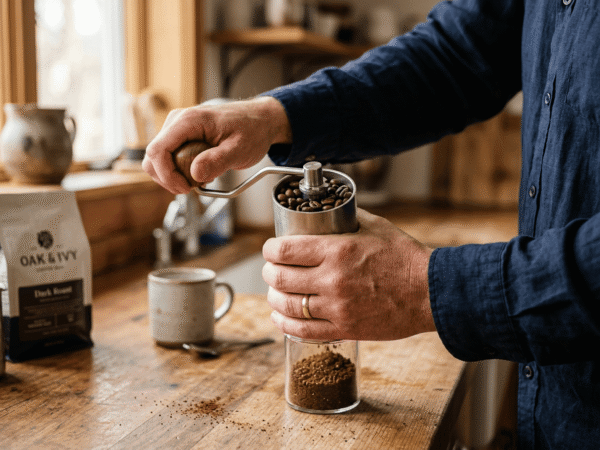
Pro tip: A burr grinder makes a massive difference for both methods. Blade grinders produce uneven particles — some too big, some too fine — which leads to inconsistent extraction. If you don’t own a burr grinder yet, even a decent hand coffee grinder will dramatically improve your results with either brewer.
Brewing Time and Effort: Your Morning Routine Matters
Let’s be real — how much time and effort you’re willing to spend at 6:30 AM affects which method you’ll actually stick with.
French Press: Set It and Wait
Total brew time: about 5–6 minutes (including boiling water and steeping).
Here’s the flow: Boil water. Grind beans. Dump grounds into the press. Pour water. Wait four minutes. Press down. Pour. Done.
The beauty of a French press is that it’s mostly passive. Once you’ve poured the water, you literally just stand there or scroll your phone. There’s no technique involved during the brew — the coffee extracts itself.
You don’t need any special pouring skills or expensive accessories. It’s genuinely a “set it and forget it” method.
Pour Over: Active and Attentive
Total brew time: about 4–5 minutes (including the bloom and pouring phases).
The process requires your active attention the entire time. You heat water, rinse the filter, add grounds, pour a small amount of water to let the coffee “bloom” (release CO2 for about 30–45 seconds), then slowly pour the rest of the water in a circular motion over 2–3 minutes.
You’re controlling the speed, direction, and amount of each pour. It’s a hands-on process. Some people find this meditative and enjoyable. Others find it annoying before they’ve had their first sip of caffeine.
The Honest Verdict on Effort
French press wins on convenience. Pour over wins on control. If you want to just make coffee and drink it, French press is easier. If you enjoy the process and want to fine-tune your cup, pour over gives you more levers to pull.
Equipment and Cost: What You’ll Actually Need
Both methods are affordable compared to espresso setups, but there are some real cost differences worth noting.
French Press Setup
A solid French press costs between $20 and $40. The Bodum Chambord and the Espro P7 (which has a double micro-filter) are popular picks in 2025. You can find cheaper ones for under $15, though they tend to crack or break faster.
Beyond the press itself, you need: a kettle (any kettle works), a grinder, and coffee. That’s it. No filters to buy, no gooseneck kettles required, no special accessories.
Ongoing cost: essentially zero beyond coffee and occasional replacement of the mesh screen (which usually lasts years).
Pour Over Setup
A basic pour over dripper like the Melitta or Kalita Wave runs $15 to $30. A Hario V60 costs around $20–$25. A Chemex, which doubles as both brewer and carafe, costs $40–$50.
But here’s the catch — you’ll want a gooseneck kettle for proper pour control. A decent one costs $25–$50 (electric gooseneck kettles with temperature control run $50–$80). And you need paper filters, which cost a few dollars per pack but add up over months and years.
If you want to get really dialed in, you might add a small kitchen scale ($15–$20) to weigh your water and coffee doses accurately.
Ongoing cost: filters. Roughly $5–$10 every few months depending on how much you brew.
Cost Summary
French press is cheaper upfront and has virtually no recurring costs. Pour over has a slightly higher total investment — especially if you buy a gooseneck kettle — and you’ll keep buying filters. Neither method will break the bank, though. We’re talking about the cost of a couple of café lattes.
How Much Coffee Can You Brew at Once?
This is a surprisingly practical question that many comparison articles skip.
A standard French press holds 32 ounces (about 4 cups). Larger models go up to 51 ounces. You can brew for yourself and a couple of friends in one go. That’s a real advantage if you’re making coffee for a household every morning.
Most pour over drippers make 1–2 cups at a time. If you’re using a single-cup dripper like the V60 01, you’re making one serving per brew. A Chemex can handle up to 6–8 cups, but the brew time gets longer, and you need to adjust your technique.
If you regularly make coffee for multiple people, a French press is way more practical. A single cup pour over coffee maker is perfect for solo drinkers who want precision, but it’s not ideal for hosting brunch.
Cleanup: Nobody’s Favorite Topic
Let’s talk about the unglamorous part.
French press cleanup is a bit annoying. You have to scoop out wet coffee grounds from the bottom of the carafe (they don’t just rinse away easily), then disassemble the plunger to wash the mesh filter. If you don’t clean it thoroughly, old oils build up and make your next brew taste rancid. The whole process takes 2–3 minutes.
Pour over cleanup is a breeze. Lift out the filter with the spent grounds, drop it in the compost or trash, rinse the dripper. Done in 30 seconds.
On the cleanup front, pour over wins without question.
Durability and Longevity
A glass French press is fragile. Drop it once, and you’re shopping for a new one. Stainless steel models (like the Espro or some IKEA options) last much longer. The mesh filter screens can wear out over time, but replacements are cheap and easy to find.
Pour over drippers made of ceramic or glass are also breakable, but they have fewer moving parts. There’s nothing to wear out — the dripper itself can last decades if you don’t drop it. Even a plastic Melitta dripper is virtually indestructible.
If longevity matters to you, a ceramic pour over dripper or a metal pour over coffee maker is about as durable as coffee equipment gets.
Which Method Is Better for Travel and Camping?
Both methods are manual — no electricity needed — which makes them travel-friendly. But there are some practical differences.
A French press is bulkier, and glass versions are a breakup waiting to happen inside a backpack. Stainless steel travel French presses exist (like the Stanley model), and they work well for camping. But they’re heavier.
A small pour over cone — especially a collapsible silicone one or a lightweight plastic dripper — weighs almost nothing and packs flat. Pair it with a best thermos for coffee or a travel coffee mug, and you’ve got a solid portable setup.
That said, for camping specifically, some folks prefer a percolator — but between these two, a lightweight pour over cone edges ahead for portability.
Caffeine Content: Is One Stronger?
People ask this a lot, and the answer might surprise you.
The caffeine difference between French press and pour over coffee is minimal when you use the same amount of coffee and water. Both methods extract caffeine efficiently.
That said, French press coffee can be slightly higher in caffeine if you’re not careful about brew time. Letting your grounds steep beyond 4 minutes continues extraction, pulling out more caffeine (and more bitterness). With pour over, the brew time is more controlled — water passes through and moves on.
If you want maximum caffeine, your bean choice matters far more than your brew method. A light roast actually retains slightly more caffeine than a dark roast (roasting burns off small amounts of caffeine). And Robusta beans contain roughly twice the caffeine of Arabica beans.
Did you know? An average 8-ounce cup of French press coffee contains about 80–100 mg of caffeine. Pour over lands in a similar range — roughly 80–95 mg. The difference is negligible.
Which One Should You Choose?
Alright, let’s stop dancing around it. Here’s my honest take based on different situations.
Go with a French press if you:
Want a rich, bold, full-bodied cup with minimal fuss. You don’t mind a little sediment. You brew for 2+ people regularly. You value convenience over precision. You prefer darker roasts and blends. You don’t want to buy recurring supplies like filters.
Go with pour over if you:
Love clean, bright, nuanced coffee where individual flavors shine. You enjoy the hands-on brewing ritual. You mostly brew for yourself. You’re into single-origin, light-to-medium roast specialty beans. You’re willing to invest in a gooseneck kettle and practice your technique. You appreciate a quick, easy cleanup.
And honestly? Many serious coffee drinkers own both. They use the French press on lazy weekends when they’re making a big batch, and the pour over on quiet mornings when they want to savor a special bag of beans. You don’t have to pick just one.
If you’re also considering other brew methods, it might help to see how the French press stacks up against an AeroPress or how it compares to a moka pot. And if you’re weighing pour over against other drippers, the V60 vs Chemex comparison is worth reading too.
FAQ
Does French press coffee taste stronger than pour over?
It tastes bolder and heavier because the metal filter allows oils and fine particles into your cup. But “stronger” in terms of caffeine? Not really — both methods produce similar caffeine levels when you use the same coffee-to-water ratio. The difference is in body and texture, not actual strength.
Can I use the same coffee beans for both French press and pour over?
Absolutely. You can use the same beans — just adjust your grind size. Coarse for French press, medium-fine for pour over. The same bag of beans will taste noticeably different depending on which method you use, which is actually a fun experiment if you’re curious about flavor profiles.
Is pour over coffee healthier than French press coffee?
There’s some evidence that filtered coffee (like pour over) may be slightly better for heart health because the paper filter traps cafestol, a compound that can raise LDL cholesterol. A 2020 study from the University of Gothenburg found that filtered coffee drinkers had a lower risk of cardiovascular disease compared to unfiltered coffee drinkers. For moderate consumption (2–3 cups daily), the difference is small — but if you drink a lot of coffee and have cholesterol concerns, pour over might be the wiser choice.
How long does a French press brew take compared to pour over?
French press takes about 4 minutes of steeping (plus a minute or two for heating water and prep). Pour over takes about 3–4 minutes of active pouring (plus bloom time). Total time is roughly similar — 5 to 6 minutes for either method. The difference is that French press time is passive (you wait), while pour over time is active (you pour).
Do I really need a gooseneck kettle for pour over?
You don’t need one, but you’ll struggle without it. A gooseneck kettle gives you a slow, precise, narrow stream of water — which is essential for even extraction in a pour over. Using a regular kettle with a wide spout makes it nearly impossible to control your pour speed and placement. If you’re serious about pour over, a gooseneck kettle isn’t optional. It’s part of the setup.
Your Next Step
Both the French press and pour over are simple, affordable ways to brew genuinely excellent coffee at home. One gives you richness and ease. The other gives you clarity and control.
If you’re still torn, here’s what I’d suggest: buy the cheaper one first. A basic French press or a plastic pour over dripper costs less than two specialty lattes. Live with it for a month. Get comfortable. Then, if curiosity pulls you, pick up the other one.
The best brewing method isn’t the one that wins internet debates — it’s the one that makes you actually look forward to your morning cup. Start there, and you really can’t go wrong.