A sip of hot chocolate that’s too hot burns your tongue. A sip that’s too warm feels flat and disappointing. And somewhere between those two extremes sits a temperature sweet spot that makes your hot chocolate taste rich, smooth, and absolutely satisfying. Most people never think about this — they just heat the milk, stir in the cocoa, and drink. But temperature changes everything about how hot chocolate tastes, feels in your mouth, and even how safe it is to drink.
The hot chocolate best serving temperature falls between 140°F and 160°F (60°C to 71°C). That’s the range where flavor compounds in cocoa open up beautifully, sweetness hits your palate the right way, and you won’t risk a scalded tongue. But that number alone doesn’t tell the whole story. There’s real science behind why this range works, how different recipes shift the ideal temperature, and what you can do to keep your cup at the perfect warmth from first sip to last.
Let’s break all of that down.
Why Temperature Matters More Than You Think
You might assume hot chocolate is just… hot chocolate. Heat it up, drink it, done. But temperature plays a much bigger role than most people realize. It affects three things simultaneously: flavor perception, texture, and safety.
Your taste buds are temperature-sensitive instruments. Research published in the journal Nature has shown that certain taste receptors activate differently depending on the temperature of what you’re consuming. Sweetness, for instance, is perceived more intensely at moderate warmth. That’s why lukewarm hot chocolate can taste overly sweet, while a scalding cup might taste more bitter than expected — even if you used the exact same recipe.
Then there’s the texture factor. Cocoa butter and milk fats behave differently at different temperatures. At the right heat, they create that velvety mouthfeel you associate with a really good cup. Too hot, and the drink feels thin and watery on your tongue. Too cool, and it starts to develop a slightly grainy quality as cocoa solids separate.
And safety? That’s the part most people overlook. The Burn Foundation notes that liquids above 160°F (71°C) can cause serious scalding injuries, and those injuries happen in less than a second at temperatures above 155°F. Children are especially vulnerable — their skin is thinner and burns at lower temperatures than adult skin.
So temperature isn’t just a preference. It’s a flavor multiplier, a texture controller, and a safety consideration all wrapped into one.
The Ideal Serving Temperature Range
Let’s put a specific number on it. The hot chocolate best serving temperature for most people falls right around 150°F (65°C). That’s the center of the sweet spot.
Here’s why 150°F works so well: at this temperature, cocoa’s complex flavor compounds — those earthy, slightly fruity, bittersweet notes that make good chocolate taste like good chocolate — are fully released as aromatic volatiles. You can actually smell the richness before the cup reaches your lips. Your taste buds are warm enough to register sweetness properly but not so overheated that bitterness dominates. And the milk proteins and fats are at an ideal state for creating a smooth, creamy texture.
But 150°F is a midpoint, not a fixed rule. The comfortable range stretches from 140°F to 160°F, and where you land within that range depends on a few things.
If you like sipping slowly, aim closer to 160°F. Your drink will cool naturally as you hold it, and you’ll spend more time in the ideal zone.
If you’re someone who drinks quickly or makes smaller portions, 140°F to 145°F is more practical. You’ll be able to take your first sip immediately without that awkward waiting period.
For kids, the safe and comfortable range is lower — between 120°F and 130°F (49°C to 54°C). The National Institutes of Health and pediatric safety organizations recommend keeping children’s hot beverages well below the adult comfort zone. Their mouths are more sensitive, and the risk of burns is significantly higher.
Pro Tip: If you don’t have a kitchen thermometer, here’s a rough guide — if you can hold the cup comfortably in your bare hands for several seconds without it feeling painful, the drink is likely in the 140°F-150°F range. If you have to keep shifting your grip, it’s probably too hot to drink safely.
What Happens When Your Hot Chocolate Is Too Hot
Most people default to “hotter is better” because they want their drink to stay warm longer. That instinct makes sense, but cranking up the heat past 160°F creates real problems.
Flavor degradation is the first casualty. Cocoa contains hundreds of volatile aromatic compounds — the things that give chocolate its complex taste. Many of these compounds are delicate. Above 170°F, some of them start to break down or evaporate out of the cup before you even take a sip. You’re literally losing flavor into the air. That’s why an overheated cup of hot chocolate can smell amazing but taste oddly flat.
Milk scalding is the second issue. If you’re making hot chocolate with real milk (as opposed to water), heating above 180°F causes the whey proteins in milk to denature and bond together. The result? A thin skin on the surface, a slightly cooked or “eggy” taste, and sometimes a grainy texture. None of these are what you want in your cup.
Sweetness suppression is the third. Your tongue’s sweetness receptors (technically called T1R2/T1R3 receptors) respond best at moderate temperatures. At very high temperatures, bitterness receptors become more active while sweetness perception drops. This is why people sometimes add extra sugar to very hot drinks — they’re compensating for a temperature problem, not a recipe problem.
And of course, there’s the burn risk. The American Burn Association reports that hot beverages are one of the leading causes of scald injuries in homes, particularly among children and elderly adults. A drink served at 180°F can cause a third-degree burn in under one second of contact with skin. That’s worth thinking about.
If you’ve been making your hot chocolate at a rolling simmer, you’ve been serving it somewhere around 200°F to 212°F. That’s way too hot — not just for safety, but for taste. Let it cool, or better yet, don’t heat it that high in the first place.
What Happens When It’s Too Cool
On the other end, hot chocolate below 130°F starts losing its appeal for adult drinkers, and below 110°F, most people would call it “room temperature cocoa” rather than hot chocolate.
Aroma drops off significantly. The steam rising from a warm cup carries volatile compounds to your nose, which is responsible for a large part of what you perceive as “taste.” (Fun fact: most of your flavor perception is actually smell, not taste.) Below 130°F, less steam means fewer aromatics reaching your nose, and the drink starts to feel one-dimensional.
Cocoa butter and fat solidify. If your hot chocolate recipe includes real chocolate or cocoa butter, these fats start to firm up as temperature drops. That’s what creates the slightly waxy coating on your palate when you drink tepid hot chocolate. Milk fats behave similarly — they lose their smooth, integrated quality and the drink begins to feel heavier and less refined.
Sweetness can become overpowering. Remember how high heat suppresses sweetness? The opposite happens at lower temperatures. A cup that tasted perfectly balanced at 150°F might taste cloyingly sweet at 100°F because your taste buds perceive sugar more aggressively in cooler conditions. This is also why melted ice cream tastes sweeter than frozen ice cream — same principle.
None of this means you can’t enjoy lukewarm hot chocolate. Some cultures traditionally drink chocolate-based beverages at room temperature or even chilled (think Mexican chocolate drinks served cold in summer). But if you’re making classic hot chocolate and want the full experience, keeping it warm enough to maintain aroma and texture is key.
How to Measure and Maintain the Right Temperature
Knowing the ideal temperature is one thing. Actually hitting it consistently — and keeping your drink there — is another challenge entirely.
Heating Methods That Give You Control
Stovetop on low-to-medium heat gives you the most control. Stir constantly, and pull the pot off heat when the milk just starts to steam visibly but isn’t simmering. That visible steam typically appears around 150°F to 160°F. If you see tiny bubbles forming at the edges of the pot, you’re approaching 170°F — time to take it off.
Microwave heating works fine, but it’s less predictable. Microwaves heat unevenly, so the top layer of your drink might be significantly hotter than the bottom. The fix? Heat in 30-second intervals, stir between each one, and check temperature. Most standard mugs of milk hit 150°F after about 90 seconds of total microwave time at full power, but this varies by microwave wattage and starting milk temperature.
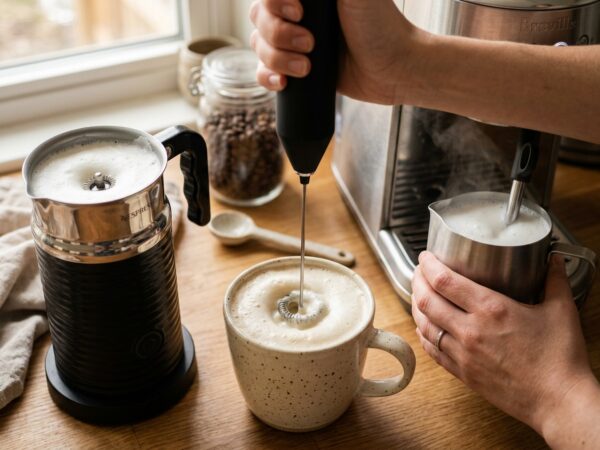
Milk frothers with heating functions are actually excellent for hot chocolate because many models have a preset temperature around 150°F to 160°F. If you already own a good coffee frother, you can use it to heat and froth your hot chocolate simultaneously. The frothing adds air, which creates a lighter texture and also slightly improves heat distribution.
Using a Kitchen Thermometer
An instant-read kitchen thermometer takes all the guesswork out. You can pick one up for under $15, and it’s useful for far more than just hot chocolate. Dip the probe into your cup, wait a few seconds, and you’ll know exactly where you stand.
Did You Know? Professional baristas and chocolatiers almost always use thermometers when preparing hot chocolate drinks. The precision makes a noticeable difference in consistency — every cup tastes the same, every time.
Keeping Your Hot Chocolate Warm Longer
One of the biggest frustrations with hot chocolate is how quickly it cools. A standard ceramic mug loses about 1°F per minute in a 70°F room. That means your 150°F drink drops below the ideal zone in about 15 to 20 minutes.
A few strategies genuinely help:
Preheat your mug. Fill it with hot tap water for a minute, dump it out, then pour your hot chocolate. A cold ceramic mug can instantly drop your drink’s temperature by 10°F to 15°F. Preheating nearly eliminates that loss.
Use a thicker mug. Thin-walled cups look elegant but radiate heat faster. A thick, heavy ceramic or stoneware mug retains heat significantly longer.
Insulated travel mugs are the best option if you’re going to be sipping over an extended period. A quality thermos designed for hot beverages can maintain temperature for hours. While they’re typically associated with coffee, they work just as well for hot chocolate. And if you’re heading out the door with your cup, a reliable travel coffee mug keeps heat locked in far better than any open-top mug.
Mug warmers (those little electric plates you set your cup on) maintain temperature around 130°F to 140°F. That’s the low end of the ideal range, but it beats letting your drink go cold.
How Different Recipes Affect Ideal Temperature
Not all hot chocolate is the same, and different recipes genuinely perform better at slightly different temperatures. Your ingredients change the equation.
Water-Based Hot Chocolate
If you’re using cocoa powder mixed with hot water (and maybe a bit of milk), you can serve at the higher end of the range — closer to 155°F to 160°F. Water-based hot chocolate is thinner, so it cools faster in the mouth and doesn’t carry heat as aggressively as fat-rich versions. The higher starting temperature compensates for the rapid cooling.
Milk-Based Hot Chocolate
Whole milk, half-and-half, or cream-based hot chocolate should be served at 145°F to 155°F. The fat content in dairy changes heat perception — fatty liquids feel hotter on the tongue than water at the same temperature because fat coats the mouth and holds heat against tissue. So you don’t need to go as high to get the same warmth sensation.
This is the same reason a sip of 150°F whole milk feels warmer than a sip of 150°F water. The fats are acting as a heat buffer against your palate.
Real Chocolate (Melted) Hot Chocolate
European-style hot chocolate made by melting actual chocolate into warm milk is thicker and richer. It should be served at the lower end — 140°F to 150°F. The cocoa butter in real chocolate has already been heated once during melting, and excessive reheating can cause the fats to separate (you’ll see oily spots on the surface). The drink’s natural thickness also retains heat longer, so it doesn’t cool as quickly as thinner versions.
Vegan/Plant-Based Hot Chocolate
Oat milk, almond milk, and coconut milk all behave slightly differently when heated. Oat milk handles heat well and can go up to 160°F without issues. Almond milk has less fat and protein, so it doesn’t create the same velvety texture — serving around 145°F helps compensate by maximizing whatever creaminess it has. Coconut milk, with its higher fat content, behaves more like dairy and does well around 145°F to 150°F.
If your brewing method matters to you — whether it’s a careful pour-over approach to coffee or a meticulous hot chocolate ritual — temperature control is a skill that transfers across all your hot drinks.
Temperature Adjustments for Special Situations
Hot Chocolate for Children
Already touched on this above, but it’s worth emphasizing. 120°F to 130°F is the safe range for kids under 10. The American Academy of Pediatrics recommends that hot beverages for young children be well below 140°F. You can make the hot chocolate at a higher temperature and then stir in a splash of cold milk to bring it down quickly. This is faster and more reliable than waiting for natural cooling.
Hot Chocolate in Insulated Bottles (for Travel or Picnics)
If you’re storing hot chocolate in a thermos for later, make it about 10°F hotter than your ideal drinking temperature. A good insulated container will lose some heat over time, and starting slightly high means you’ll be in the sweet spot when you actually pour and drink. So aim for 160°F to 165°F at the time you seal the thermos.
Hot Chocolate with Alcohol
Spiked hot chocolate (with bourbon, rum, Baileys, or peppermint schnapps) should be served around 140°F to 145°F, slightly lower than standard. Alcohol evaporates at 173°F, and while your drink isn’t reaching that temperature, higher serving temps will cause alcohol to volatilize faster, losing both flavor and potency. The lower temperature keeps the boozy notes integrated into the drink rather than floating away as vapor.
Hot Chocolate with Whipped Cream or Marshmallows
If you’re topping your cup with whipped cream or marshmallows, serve the hot chocolate at the higher end — 155°F to 160°F. The cold topping will immediately drop the surface temperature. Starting a bit hotter ensures the drink underneath stays in the comfort zone even after the cold topping is added.
The Science of Cocoa Flavor and Heat
Here’s something interesting that most hot chocolate articles skip over: cocoa’s flavor profile changes measurably at different temperatures, and food scientists have actually studied this.
A 2019 study in the Journal of Food Science examined how temperature impacts flavor perception in chocolate-based beverages. Researchers found that bitterness peaked at temperatures above 160°F, while sweetness and creaminess peaked between 140°F and 155°F. Fruity and floral notes in higher-quality cocoa were most detectable around 145°F.
This aligns with what chocolatiers have known for centuries. In Belgium and Switzerland, where hot chocolate is treated as a craft, serving temperature is carefully controlled. Many artisan chocolate shops in Brussels serve their hot chocolate at precisely 65°C (149°F) — not because they read a study, but because generations of experience led to the same conclusion.
The Maillard reaction — the same chemical process that gives seared steak its crust and coffee beans their roasted depth — also plays a role during the initial cooking. If you’re heating milk with cocoa powder, a gentle heat allows a mild Maillard reaction between the milk sugars and cocoa proteins, creating deeper flavor complexity. Overheating pushes this reaction too far and creates burnt, acrid notes.
The takeaway? Treating your hot chocolate’s temperature with even half the care that coffee enthusiasts put into their French press grind size or brewing method comparisons will noticeably improve your results.
Quick Reference: Temperature Guide at a Glance
Since this can be a lot to remember, here’s a simple breakdown:
- Adults (standard mug): 140°F–160°F (60°C–71°C), sweet spot at 150°F (65°C)
- Children (under 10): 120°F–130°F (49°C–54°C)
- Thermos/travel storage: Start at 160°F–165°F to account for cooling
- Alcohol-spiked versions: 140°F–145°F to preserve alcohol flavor
- With cold toppings: 155°F–160°F to offset temperature drop from whipped cream or marshmallows
FAQ
What is the best temperature to serve hot chocolate?
The ideal serving temperature for hot chocolate is between 140°F and 160°F (60°C to 71°C), with 150°F (65°C) being the most commonly recommended sweet spot. At this temperature, cocoa flavors are fully expressed, sweetness is balanced, the texture is smooth, and the drink is warm enough to enjoy without any risk of burning your mouth.
Can hot chocolate be too hot to taste good?
Yes, absolutely. Above 160°F, bitterness becomes more prominent, sweetness perception drops, and delicate cocoa aromatics start to break down or evaporate. Milk heated above 180°F can develop a scalded, cooked flavor and form an unpleasant skin on the surface. For both taste and safety, keeping your hot chocolate below 160°F is the better choice.
How do I keep hot chocolate warm without overheating it?
Preheat your mug with hot water before pouring, use a thick ceramic or stoneware mug, or transfer your drink into an insulated thermos for long-lasting warmth. Electric mug warmers also work well and typically maintain temperatures around 130°F to 140°F. Avoid reheating on the stove or in the microwave repeatedly, as each cycle can degrade flavor.
Is the ideal hot chocolate temperature different for kids?
Yes. Children’s skin is thinner and more sensitive to heat, so hot chocolate for kids should be served between 120°F and 130°F (49°C to 54°C). You can make it at a higher temperature and stir in a splash of cold milk to bring it down quickly before serving.
Does the type of milk change the ideal serving temperature?
It does, slightly. Whole milk and cream-based hot chocolate feel warmer on the tongue due to their fat content, so you can serve at 145°F to 150°F. Water-based or skim milk versions cool faster in the mouth and benefit from a slightly higher starting temperature around 155°F to 160°F. Plant-based milks vary — oat milk handles higher heat well, while almond milk does better at 145°F.
Your Next Cup Deserves a Thermometer
Temperature might seem like a small detail, but it’s honestly one of the easiest upgrades you can make to your hot chocolate routine. You don’t need fancy equipment or rare ingredients. You just need to stop guessing and start paying attention to heat.
Grab a $10 instant-read thermometer, aim for 150°F, and taste the difference yourself. Once you experience a cup that’s properly tempered — not scalding, not lukewarm, but right in that flavor-rich, velvety sweet spot — you won’t want to go back to winging it.
And honestly? That same temperature awareness will improve everything else you make, from coffee to tea to soup. Good food and drink deserve a little precision. Your taste buds will thank you.