A moka pot is unforgiving. Use the wrong grind size and you’ll either get a weak, watery cup or a bitter, over-extracted mess that tastes like burnt rubber. The grinder you pair with your moka pot matters more than the beans, the water temperature, or even the pot itself. Yet most buyers grab whatever grinder is on sale without thinking about whether it can actually hit that specific medium-fine sweet spot a moka pot demands.
If you’ve been struggling with channeling, sputtering, or coffee that just doesn’t taste right, the grinder is almost always the culprit. This guide breaks down the best coffee grinders for moka pot brewing — manual and electric, budget and premium — so you can stop guessing and start making rich, full-bodied stovetop espresso every single morning.
Why Your Grinder Matters More Than Your Moka Pot
Here’s something most people don’t realize: the moka pot itself is a pretty simple device. Water heats up, steam pressure pushes it through ground coffee, and brewed coffee rises into the upper chamber. There aren’t many variables you can control. You can’t adjust pressure like on an espresso machine. You can’t control flow rate like with a pour-over. The one thing you can control with precision is your grind.
That’s why the grinder is the single most important piece of equipment in your moka pot setup. A $30 Bialetti paired with a great grinder will produce better coffee than a $100 moka pot paired with a blade grinder. Every time.
What happens with the wrong grind? If your grounds are too fine (espresso-level), the water can’t push through properly. You’ll hear sputtering, the coffee will taste harsh and bitter, and you might even get a dangerous pressure buildup. Too coarse, and the water rushes straight through without extracting enough flavor, leaving you with something that tastes like slightly brown water.
The target for moka pot brewing is medium-fine — think slightly coarser than espresso but noticeably finer than what you’d use for drip coffee. It should feel like table salt between your fingers, not powdery like flour and not gritty like sea salt. If you’re curious about how the moka pot’s brewing style compares to other methods, our French press vs. moka pot comparison breaks that down nicely.
Getting this grind size consistently is where cheap grinders fail and quality grinders shine.
Burr vs. Blade: Why It’s Not Even Close
You’ve probably seen this debate before, so I’ll keep it brief and honest.
Blade grinders chop beans randomly. Some particles end up powder-fine while others stay chunky. This inconsistency means some of your coffee over-extracts (bitter) while some under-extracts (sour) — all in the same cup. For moka pots, where grind consistency directly affects pressure and flow, blade grinders are a recipe for frustration.
Burr grinders crush beans between two abrasive surfaces set at a specific distance apart. Every particle comes out roughly the same size. You get a uniform extraction, which translates to balanced flavor and repeatable results.
Within burr grinders, you’ve got two types: conical burrs and flat burrs. Conical burrs are more common in home grinders and hand grinders. They run cooler, are quieter, and work great for moka pot grind sizes. Flat burrs tend to produce even more uniform particle distribution, but they’re usually found in pricier machines aimed at espresso enthusiasts.
For moka pot brewing specifically, a good conical burr grinder is all you need. You don’t have to spend espresso-grinder money to get excellent results.
Pro Tip: If you already own a blade grinder and aren’t ready to upgrade, try pulsing in short bursts and shaking the grinder between pulses. It’s not ideal, but it helps reduce inconsistency. For more creative workarounds, check out our guide on how to grind coffee beans without a grinder.
What to Look for in a Coffee Grinder for Moka Pot
Before we get to specific models, let’s talk about what actually matters. Not every feature on the box translates to better coffee. Here’s what you should genuinely care about:
Grind Consistency at Medium-Fine
This is the big one. Some grinders are fantastic at coarse settings but produce a lot of dust and fines when you tighten the adjustment down to medium-fine. Read reviews that specifically mention moka pot or stovetop espresso use — that tells you more than any spec sheet.
Step vs. Stepless Adjustment
Stepped grinders click between preset settings. They’re easy to use and you can always return to your favorite setting. Stepless grinders let you dial in continuously, giving you micro-adjustments. For moka pot brewing, either works well. But if you’re the type who likes to fine-tune, stepless gives you more control.
Burr Material
Steel burrs are standard and perfectly good for moka pot use. Ceramic burrs stay sharp longer and don’t transfer heat, but they can chip if you accidentally grind a small stone hiding in your beans. Both work. Don’t let anyone tell you one is dramatically superior to the other for this specific use case.
Capacity and Speed
A typical 3-cup Bialetti needs about 15-17 grams of coffee. Even the smallest hand grinders handle that without issue. If you’re brewing a 6-cup or 9-cup moka pot regularly, you might want a grinder with a larger hopper — or at least one that grinds quickly so you’re not cranking a hand grinder for five minutes every morning.
Retention
Grind retention is the amount of coffee that gets stuck inside the grinder after each use. High retention means you’re wasting beans and potentially mixing stale leftover grounds into your next batch. Look for grinders with low retention, especially if you only brew one small moka pot at a time.
7 Best Coffee Grinders for Moka Pot Brewing
1. 1Zpresso JX — Best Manual Grinder Overall
The 1Zpresso JX has earned an almost cult-like following among home coffee enthusiasts, and for good reason. Its 48mm stainless steel conical burrs produce remarkably consistent grounds at the medium-fine setting a moka pot needs. The adjustment mechanism is external, with clearly numbered settings, so you can switch between moka pot and other brew methods without losing your place.
Grinding 15-17 grams of coffee takes about 30-45 seconds. It’s fast, smooth, and requires less effort than most hand grinders. Build quality is excellent — the body is aluminum alloy, the handle feels solid, and the whole thing weighs under 400 grams.
Who it’s for: Anyone who wants the best balance of grind quality, speed, and price in a hand grinder. It’s particularly great for people who also use a French press or drip coffee maker and want one grinder that handles multiple brew methods.
Price range: Around $70-$80
One thing to know: The JX has stepped adjustments. Each click makes a noticeable difference in grind size, which is fine for moka pot. If you want micro-adjustments for espresso-level precision, look at the JX-Pro instead.
2. Timemore Chestnut C3 — Best Budget Manual Grinder
If $70+ feels steep for a hand grinder, the Timemore Chestnut C3 is where you should look. It typically sells for around $40-$55, and it punches well above that price point. The 38mm stainless steel burrs produce surprisingly uniform grounds, and the 36-click adjustment system gives you enough range to dial in a nice medium-fine setting.
It’s compact and light, which makes it a solid travel companion. The grinding experience is smooth, though noticeably slower than the 1Zpresso due to the smaller burr size. Expect about 60-90 seconds to grind enough for a 3-cup moka pot.
Who it’s for: Budget-conscious buyers, students, travelers, and anyone just getting started with freshly ground coffee. If you’re upgrading from pre-ground coffee or a blade grinder, the improvement will be dramatic.
Price range: $40-$55
One thing to know: The plastic catch cup on older models had static issues that caused grounds to cling and scatter. Timemore has improved this on newer versions, but tapping the grinder lightly after grinding still helps.
3. Baratza Encore ESP — Best Electric Grinder Under $200
The Baratza Encore has been a home coffee staple for over a decade, and the ESP version is specifically tuned for finer grind settings. That makes it a natural fit for moka pot brewing. Where the original Encore sometimes struggled in the medium-fine range, the ESP version adds more granularity in exactly that zone.
It’s an electric conical burr grinder with 40mm steel burrs and 40 grind settings. Operation is simple — load the hopper, set your grind, press the button. It grinds a moka pot dose in about 10 seconds. Cleanup is straightforward, and Baratza is known for excellent customer support and widely available replacement parts. This thing is built to be repaired, not thrown away.
Who it’s for: Anyone who wants an electric grinder that’ll last years without fuss. It’s perfect if you brew every morning and don’t want to hand-grind before you’ve even had your first sip.
Price range: $170-$200
One thing to know: The Encore ESP has slightly higher retention than hand grinders (about 1-2 grams can stay in the chute). Give the side a firm tap after grinding, or keep a grinder brush handy.
4. 1Zpresso Q2 S — Best Ultra-Portable Grinder
Traveling with a moka pot? Camping? Living in a tiny apartment and short on counter space? The 1Zpresso Q2 S was made for you. It’s about the size of a travel mug and weighs just 340 grams, but it still uses quality stainless steel burrs with a seven-core design that grinds efficiently for its size.
The adjustment is internal (you remove the handle and turn a dial inside), which is slightly less convenient for switching between settings but keeps the grinder compact. For moka pot use, you’ll set it once and rarely change it.
Who it’s for: Travelers, minimalists, and anyone who wants a quality grinder that fits in a bag. If you’re the kind of person who packs a Bialetti for camping trips or hotel stays, this is its perfect companion. And if you’re taking your setup on the road, a great travel coffee mug completes the kit.
Price range: $65-$80
One thing to know: The small 20-gram capacity is fine for moka pot doses but not ideal if you’re grinding for multiple brew methods or larger batches.
5. Baratza Virtuoso+ — Best Mid-Range Electric Grinder
Think of the Virtuoso+ as the Encore’s more refined older sibling. It uses the same size burrs but with a different cutting geometry that produces noticeably more consistent grounds, especially in the medium-fine range. The digital timer lets you set a precise grind time, so you get repeatable doses every morning.
The 40 grind settings give you plenty of room to fine-tune your moka pot grind, and the grounds bin sits flush with the body to minimize mess. It’s quiet enough to use early in the morning without waking the household.
Who it’s for: Home brewers who want a step up from the Encore without jumping to $300+ espresso-grade grinders. Also a great choice if you switch between moka pot and drip methods — its range covers both beautifully. Speaking of which, if you’re also shopping for a drip setup, our guide to the best coffee grinders for drip coffee covers that side of things.
Price range: $250-$280
One thing to know: Some users report that the rubber gasket around the grounds bin can trap a small amount of fine coffee dust. A quick wipe every few days keeps things clean.
6. Comandante C40 MK4 — Best Premium Hand Grinder
The Comandante C40 is the gold standard of hand grinders. Its high-nitrogen martensitic steel burrs are manufactured in Germany, and the grind consistency rivals electric grinders costing twice as much. Every click of its adjustment mechanism produces a clear, deliberate change in particle size, and the medium-fine range is where this grinder truly excels.
Grinding feels effortless. The ergonomics are dialed in — the knob shape, the grip texture, the bearing smoothness. It’s the kind of tool that makes the ritual of hand grinding feel like a pleasure rather than a chore.
Who it’s for: Serious coffee enthusiasts who want the absolute best grind quality from a manual grinder and don’t mind paying for it. If you appreciate craftsmanship and plan to keep this grinder for a decade, it’s worth the investment.
Price range: $250-$290
One thing to know: At this price, you’re paying a premium for precision engineering and materials. If your budget is tight, the 1Zpresso JX gets you 85-90% of the way there for a third of the cost.
7. Eureka Mignon Notte — Best Electric Grinder for Espresso and Moka
If you use both an espresso machine and a moka pot (or plan to eventually), the Eureka Mignon Notte is worth a serious look. It’s a flat burr grinder with 50mm hardened steel burrs, stepless adjustment, and extremely low retention. Italian-made — fitting, since the moka pot is Italian too.
The stepless design means you can land on exactly the right grind size for your specific moka pot, your specific beans, and your specific taste preference. Grind quality at the medium-fine setting is outstanding, with very few fines or oversized particles.
It’s also remarkably quiet for an electric grinder, thanks to sound-dampening insulation in the housing. Eureka calls it “silent” technology, and while that’s a stretch, it’s noticeably quieter than most competitors.
Who it’s for: Anyone who wants one electric grinder that handles both moka pot and espresso-level fineness. It’s also a smart pick if you suspect you’ll upgrade to an espresso machine someday — this grinder will grow with you.
Price range: $200-$250
One thing to know: The Notte doesn’t include a timer by default (you hold the button to grind). The Eureka Mignon Manuale adds a timer for slightly more money if that matters to you.
Manual vs. Electric: Which Makes More Sense for Moka Pot?
This is a genuinely personal decision, and either can work brilliantly. Here’s how to think about it.
Choose a manual grinder if you brew one small moka pot at a time, you enjoy the ritual of hand grinding, you value portability, or you want the best grind quality per dollar spent. A $70 hand grinder often matches or beats a $200 electric grinder in terms of grind consistency. That’s just the reality of where your money goes — in a hand grinder, nearly all of it goes into the burrs and mechanism. In an electric grinder, a big chunk goes toward the motor, housing, and electronics.
Choose an electric grinder if you brew larger quantities, you need speed in your morning routine, or you simply don’t want to exert physical effort before coffee. No judgment there. If you’re making a 6-cup moka pot every day, hand grinding gets old quickly.
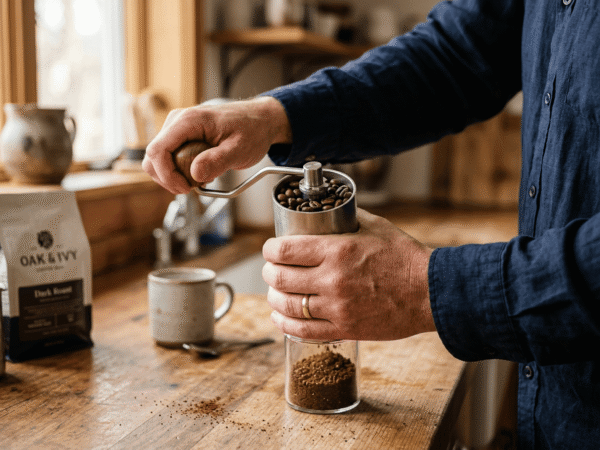
A quick note on hand grinding technique: if you go the manual route, use a smooth, consistent cranking motion. Don’t jerk the handle or change speed mid-grind — this actually affects particle consistency. Our full guide on using a hand coffee grinder walks through proper technique.
How to Dial In Your Grinder for a Moka Pot
Buying the right grinder is only half the battle. You also need to find your ideal setting. Here’s a practical process that works regardless of which grinder you own.
Start in the middle of the medium-fine range. Every grinder labels its settings differently, so check the manufacturer’s recommended range for moka pot or stovetop espresso. If there’s no specific recommendation, aim for about one-third of the way from the finest setting toward coarse.
Brew a test batch. Use your normal water amount and heat level. Pay attention to two things: how long the coffee takes to start flowing into the upper chamber, and what it tastes like.
If the brew takes too long to start flowing (more than 3-4 minutes from heat-on to first coffee appearing), sputters aggressively, or tastes harsh and bitter, your grind is too fine. Adjust one or two clicks coarser.
If coffee flows almost immediately and looks pale and watery, or if it tastes sour and thin, your grind is too coarse. Adjust one or two clicks finer.
Change one variable at a time. Don’t adjust grind size AND water amount AND heat level all at once. Tweak the grind, brew again, taste again. Most people find their ideal setting within three or four attempts.
Did You Know? The ideal brew time for a moka pot (from heat on to coffee finished) is typically 4-5 minutes total. If yours is wildly faster or slower, grind adjustment is the first fix to try.
Keep a note. Once you find the setting that produces your perfect cup, write it down or snap a photo of the grinder’s position. Different beans may need slight adjustments (lighter roasts often benefit from going slightly finer), but your baseline setting saves you from starting over each time.
And don’t forget that bean freshness plays a huge role too. Coffee that’s been sitting open for weeks loses gas and changes how it extracts. Proper coffee bean storage makes a noticeable difference in how your grind behaves in the moka pot.
Common Mistakes That Ruin Moka Pot Coffee (and How Your Grinder Plays a Role)
Using espresso-fine grounds. This is the most common mistake. Yes, moka pot coffee is sometimes called “stovetop espresso,” but it brews at much lower pressure than a real espresso machine (about 1.5 bar vs. 9 bar). Espresso-fine grounds create too much resistance, leading to over-extraction, bitterness, and potentially unsafe pressure buildup. Medium-fine is the target — noticeably coarser than true espresso.
Grinding too far in advance. Ground coffee starts losing flavor within minutes of grinding. If you’re investing in a quality grinder, use it right before you brew. Grinding the night before for your morning moka pot defeats much of the purpose.
Not cleaning the grinder. Old grounds trapped in the burrs go stale and rancid. Every time you grind fresh beans, they pick up those off-flavors. Brush out your grinder every week or two, and do a deep clean monthly. Most hand grinders disassemble easily for this. Electric grinders usually have a removable upper burr.
Ignoring grind consistency problems. If your grinder is producing a mix of very fine powder and larger chunks (you can see this if you spread grounds on a white plate), it’s either a low-quality grinder, worn burrs, or misaligned burrs. No amount of technique will fix bad grind consistency — the grinder itself needs to be addressed.
FAQ
What grind size should I use for a moka pot?
Aim for medium-fine, roughly the texture of table salt. It should be coarser than espresso grind but finer than what you’d use for a standard drip coffee maker. On most grinders, this falls in the lower-middle portion of the adjustment range. The exact setting varies by grinder brand and model, so use the manufacturer’s brew guide as a starting point and adjust by taste.
Can I use a blade grinder for a moka pot?
You can, but you shouldn’t expect great results. Blade grinders produce extremely inconsistent particle sizes, which causes uneven extraction in a moka pot. You’ll get a mix of over-extracted bitterness and under-extracted sourness in the same cup. If a blade grinder is all you have right now, pulse in short 2-3 second bursts, shake the grinder between pulses, and sift out any large chunks. But upgrading to even a budget burr grinder like the Timemore C3 will transform your moka pot coffee.
Is a hand grinder or electric grinder better for moka pot?
Neither is inherently “better” — they serve different needs. A hand grinder typically offers superior grind consistency per dollar and is more portable. An electric grinder is faster and more convenient, especially for larger doses. If you brew a small 3-cup moka pot, a hand grinder is perfect. If you’re brewing 6+ cups daily or simply value speed in the morning, go electric. Both types can produce excellent moka pot results if you choose a quality model.
How much should I spend on a grinder for moka pot?
A good moka pot grinder doesn’t have to be expensive. The Timemore Chestnut C3 at around $40-$55 produces genuinely good results. The sweet spot for most people is $70-$100 for a hand grinder or $170-$250 for an electric grinder. Spending more than that gets you incremental improvements in consistency and build quality, but the jump from a $40 grinder to a $70 grinder is far more dramatic than the jump from $70 to $250.
Do I need a different grinder for moka pot than for drip or French press?
Not necessarily. Most quality burr grinders cover a wide enough range of grind sizes to handle moka pot, drip, and French press. The key is making sure the grinder performs well at the specific setting you need. Some grinders excel at coarse settings (great for French press) but struggle with medium-fine consistency. If you own multiple brewers and want guidance on grind for each, our article on French press grind size covers that end of the spectrum.
Your Next Step
The right grinder turns a moka pot from a frustrating gadget into a daily ritual you actually look forward to. If you’re on a budget, start with the Timemore Chestnut C3 — it’ll immediately improve your coffee for under $55. If you’re ready to invest in something you’ll use for years, the 1Zpresso JX (manual) or Baratza Encore ESP (electric) are both excellent choices that won’t let you down.
Whichever grinder you pick, remember this: grind fresh, grind consistent, and dial in your setting by taste. Your moka pot will thank you with the richest, most flavorful cup it’s ever produced.